
Sources for Cerritos Previous Residents
A search for previous residents needs an era map before it needs a name. Los Angeles County's recorded real-estate series reaches back to 1851 in the main access description, with 1851-1957 records reviewed on the lower level at Norwalk and 1958-present on the second floor. The public Assessor portal supplies current parcel facts, while Cerritos city files and regional historical collections fill different date gaps.
| Source | Years it covers | Where held | What it shows |
|---|---|---|---|
| RR/CC real-estate records | 1851-present in access materials; County pages also say 1850 | Norwalk appointment and copy channels | Grantor, grantee, legal description, recording date, document number |
| Assessor parcel roll | Current and roll-preparation snapshot | LA County Assessor Portal | AIN, situs, use, values, building facts, map links |
| City and reverse directories | Regional runs vary; L.A. digitized directories 1873-1970 | LAPL and library collections | Listed occupants, subscribers, addresses, household clues |
| Federal census | Latest released schedule is 1950 under the 72-year rule | NARA and research libraries | Household relationships, age, birthplace, trade |
| Cerritos permits and planning | Earliest surviving year not verified | City Clerk and Community Development | Project dates, applicants, approvals, building changes |
| Vital, obituary, and probate records | Record-specific coverage and eligibility | RR/CC, CDPH, LASC, libraries | Death, family, heirs, and life-event endpoints |
Start with the source closest to the era in question. For a new tract home, the first deed and permit may come before a directory entry. For an older property, legal descriptions and county books may be more stable than street labels. For the household layer, use directories and census records, then close the trail with vital or probate material.
Begin with the Current Cerritos Parcel
Enter the address in the Los Angeles County Assessor Portal and capture the AIN, situs, parcel type, use, legal or tract clues, building facts, values, map links, and effective date. The public page does not show the owner. Obtain the current owner's name through the Assessor counter or an authorized county channel before attempting the deed index.
The AIN and legal description are the anchor for finding previous residents. They help reject a same-name deed on another parcel, connect a tract map to a later address, and preserve the land identity when a mailing label changes. Keep the situs address separate from a tax or return-to address. A deed return address may show where mail went, not where the person lived.
- AIN
- Assessor Identification Number, the county's parcel key.
- Legal description
- Recorded tract, lot, block, or other land language that can outlast a street label.
- Situs
- Physical location of the parcel, distinct from a mailing destination.
- Chain of title
- The sequence of recorded transfers that connects one title party to an earlier one.
The parcel card supplies the present starting point. It does not, by itself, name previous residents or prove that an owner occupied the address.
Tracing Past Owners Through LA County Deeds
Los Angeles County's RR/CC real-estate index is searched in person at Norwalk by grantor name, grantee name, and recording year. There is no Internet address index, and staff will not perform a telephone search. That office-only rule is the key local fact in a workflow for previous residents. The county's public pages describe the series as 1850 or 1851; use the practical 1851-present coverage statement while preserving the discrepancy in a research note.
- Bring the current owner name, AIN, legal description, and a range of likely acquisition years to the appointment.
- Search the current owner as grantee. Record every plausible document number, recording date, grantor, legal description, and AIN.
- Open the acquisition deed and verify that the legal parcel matches the target address.
- Search the seller as grantee in an earlier year. That seller's acquisition is the next step backward.
- Repeat until the relevant era is reached, then use directory and census sources for occupants rather than assuming title and residence are the same.
At Norwalk, 1851-1957 records are reviewed on the lower level and 1958-present records on the second floor. Copies can be ordered online, by mail, or in person after identifying the document. The County says the full document must be purchased. A chain note should include the recording date, index role, document number, legal description, and any gap.
Counter preparation. Carry all spelling variants, approximate years, the AIN, and the legal description. A street address alone cannot drive the RR/CC index search.
Turn Each Seller into an Earlier Grantee
The backward deed method is a role change. On the present deed, the buyer is the grantee and the seller is the grantor. To find the seller's prior acquisition, search that grantor as a grantee in an earlier recording year. Repeat the same move. The chain can reveal title history, liens, easements, notices, and legal descriptions, but it still describes recorded interests rather than a full list of former residents.
| Grantor | Person or entity transferring an interest in the document. |
|---|---|
| Grantee | Person or entity receiving an interest in the document. |
| Recording date | Date the County placed the instrument in its record series. |
| Legal description | Land language used to confirm that a name belongs to the target parcel. |
| Document number | Key for ordering and citing the complete instrument. |
Do not fill a gap with a guessed transfer. A missing year may reflect a different instrument type, a name variant, a record that needs counter review, or a change in the parcel's legal description. Write “not located” with the years and variants checked. That is more useful than hiding uncertainty.
Bridge Cerritos Addresses with Directories
Ownership is only half of the previous residents question. Regional city and reverse directories can add a listed occupant or subscriber for a given year. LAPL's verified Los Angeles city directories run 1873-1942 in paper and microfilm, while digitized L.A. city and street directories cover 1873-1970 with uneven county reach. Cerritos Library provides local history and catalog help but does not publish a verified Cerritos-only year run.
Search Cerritos and Dairy Valley, then test Los Angeles County, Artesia, Norwalk, Bellflower, tract, ranch, and subdivision headings. Read the abbreviation key in each volume. A directory residence may not be legal domicile, a subscriber may not represent all household members, and a missing name may reflect an unlisted number or a geography gap. The collections and entry-reading method are detailed on the Cerritos city directory page.
The LAPL genealogy guide is the regional starting point for directories, vital indexes, newspapers, and obituary research. Save the title, year, page, and place heading beside each entry.
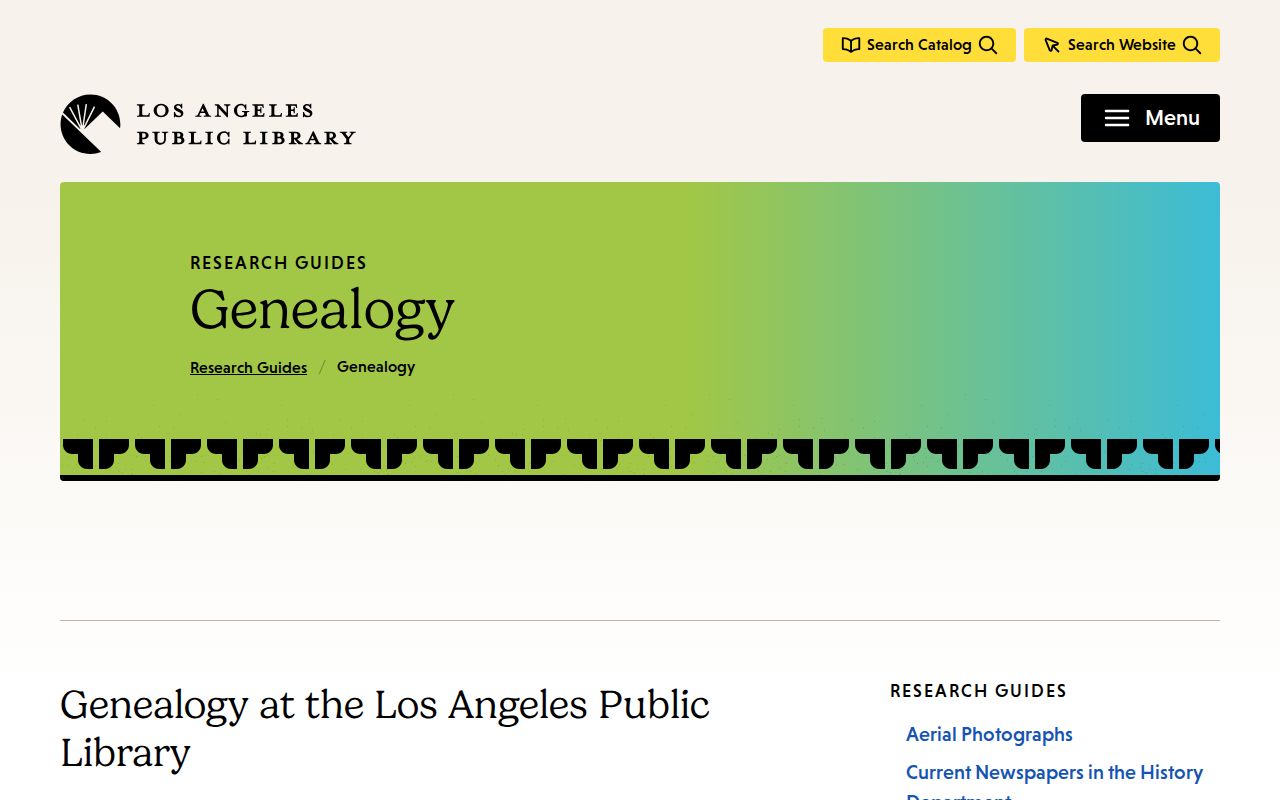
The library capture supports the bridge from a recorded title chain to the household clues that a deed cannot supply.
Pair Cerritos Directory Years with Census
A directory can show a short interval for previous residents; a census can show a household at one federal enumeration. The 1950 census is the latest released schedule under the 72-year rule in 2026. Pair the closest directory edition with the matching census year, then test age, relatives, birthplace, trade, address, and enumeration district. Earlier Cerritos-area schedules may use county or unincorporated geography rather than the present city name.
- Transcribe the directory entry and mark the exact year, address, spouse, trade, and publisher terms.
- Find the likely census enumeration district using the historical place name and map context.
- Compare household members, ages, birthplaces, and address clues without forcing a match.
- Check the directory before and after the census to bracket arrival, departure, or a move.
- Use a death index, obituary, probate petition, or later deed to test what happened next.
National Archives census guidance explains the release framework. A census household and a directory subscriber answer different questions. Together they can narrow when a past household was associated with the address, but neither source guarantees continuous occupancy.
Date Cerritos Changes with Permits
Cerritos's municipal permit and planning files can date building work, subdivision growth, and major alterations. Requests go through the City Clerk. The GIS and Community Development layer can add entitlement history, zoning, aerial context, and map relationships. The earliest surviving year of the city's permit files was not verified, so an old address should not be assigned a construction date without a file or dated map.
Permit applicants, contractors, owners, and design professionals are roles in a project record. They are not a complete household list. Building plans have tighter inspection and copying limits: viewing is arranged through Building and Safety at (562) 916-1209, and copies generally require the property owner or authorization from the original design professional. A focused California Public Records Act request can ask for a permit file by address and date range.
| Permit history | Project type, address, date, applicant, contractor, or inspection clues when held. |
|---|---|
| Entitlement history | Planning approvals tied to a site, such as a variance or precise plan. |
| Tract or parcel map | Lot and block framework that can connect old legal descriptions to later addresses. |
| Plan file | Viewing and copying have owner or design-professional limits. |
Close a Past Resident Trail
Obituaries, death records, and probate files can close a trail involving previous residents or connect a household to heirs. Los Angeles County RR/CC supplies county death records and public marriage routes. CDPH supplies statewide vital records. Los Angeles Superior Court holds probate petitions and wills in case files, not with the Recorder. LAPL notes that metropolitan obituary coverage is incomplete, so a missing notice is not proof that a person did not die or live at the address.
Los Angeles County death-record guidance is the local starting point for an eligible copy. County birth-record guidance and marriage-record guidance cover different event routes. CDPH copy guidance explains the statewide route and the difference between authorized and informational copies. For a probate heir, use the court file and then verify any parcel connection through the deed chain.
The county death-record capture in the manifest shows the life-event route that can finish a house-history search.
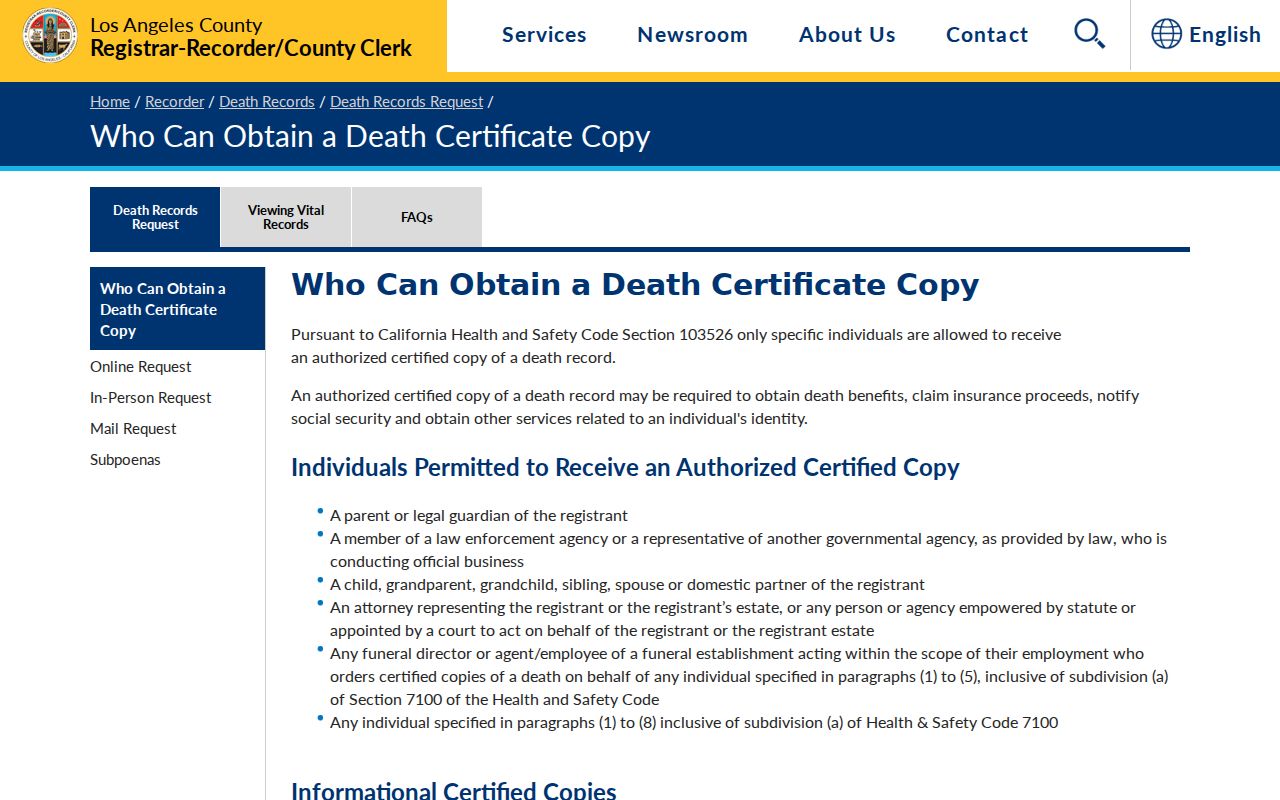
A death record can establish an event and named parties. It does not automatically prove that the person was the last occupant of the parcel.
The state vital-record capture shows the form-based route for a documented life event. The current CDPH fee page gives the amount to verify before mailing. Use the event date and jurisdiction that existed at the time.
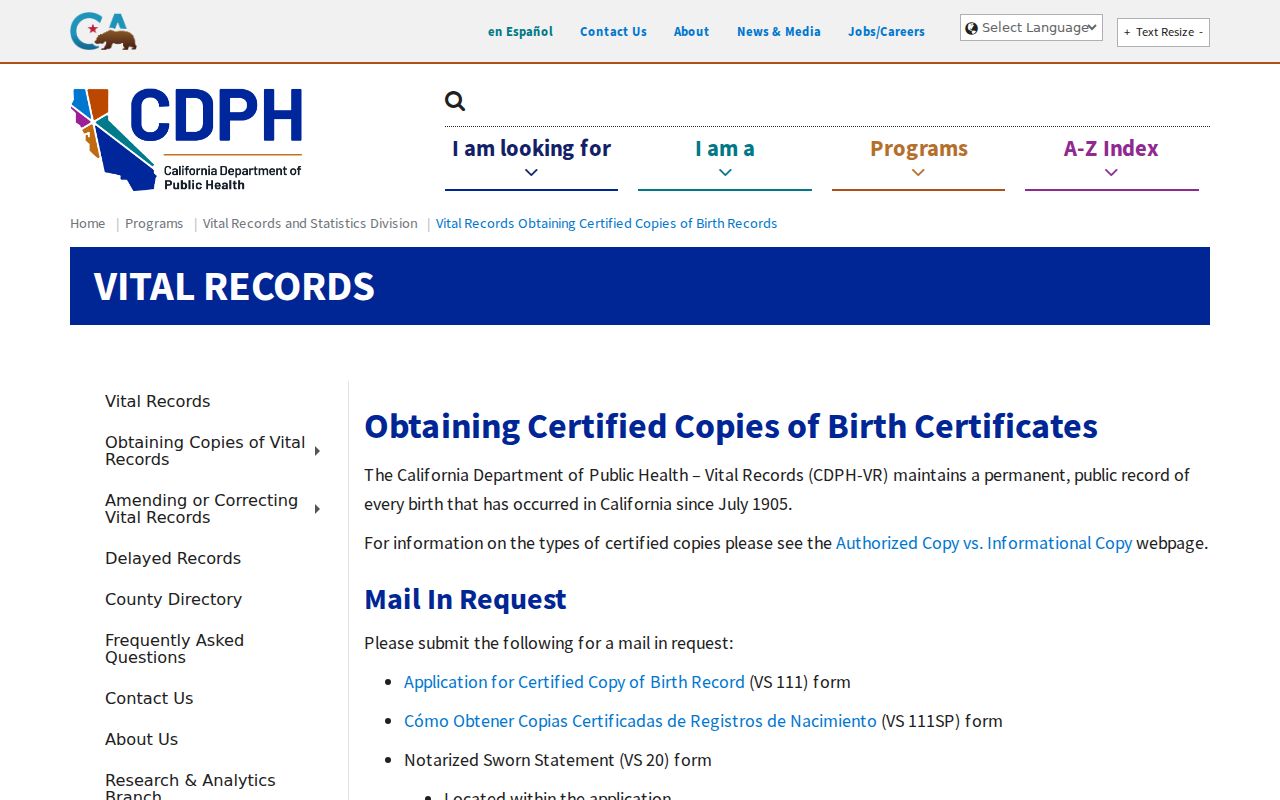
The state form adds a second custodian and a second eligibility check rather than a universal public name index.
Cerritos Past Households Need Context
Cerritos's rapid development makes “first resident” claims especially fragile. The city reports 31 residential tracts completed or underway by April 1968 and 3,367 permits in 1971. A tract home can have a first deed, a permit, a directory appearance, a census household, and later title transfers that do not line up on one date. Use the source that matches the question: deeds for title, directories for listed occupants, census for household structure, and permits for construction.
The city's name change adds another layer. Search Dairy Valley for 1956-1966 and Cerritos from 1967, then test county and nearby-community terms. No verified citywide renumbering project was found, so use the AIN, tract, lot, and legal description to bridge address changes instead of inventing a renumbering year.
Lawful house history. Research into Cerritos previous residents is for family history, estate work, house history, and personal curiosity. Do not use a past-resident trail to stalk, harass, intimidate, or harm any living person.
A careful record of previous residents ends with a source list, date range, and uncertainty note. That makes the history useful without claiming that a partial record is a complete household roll.